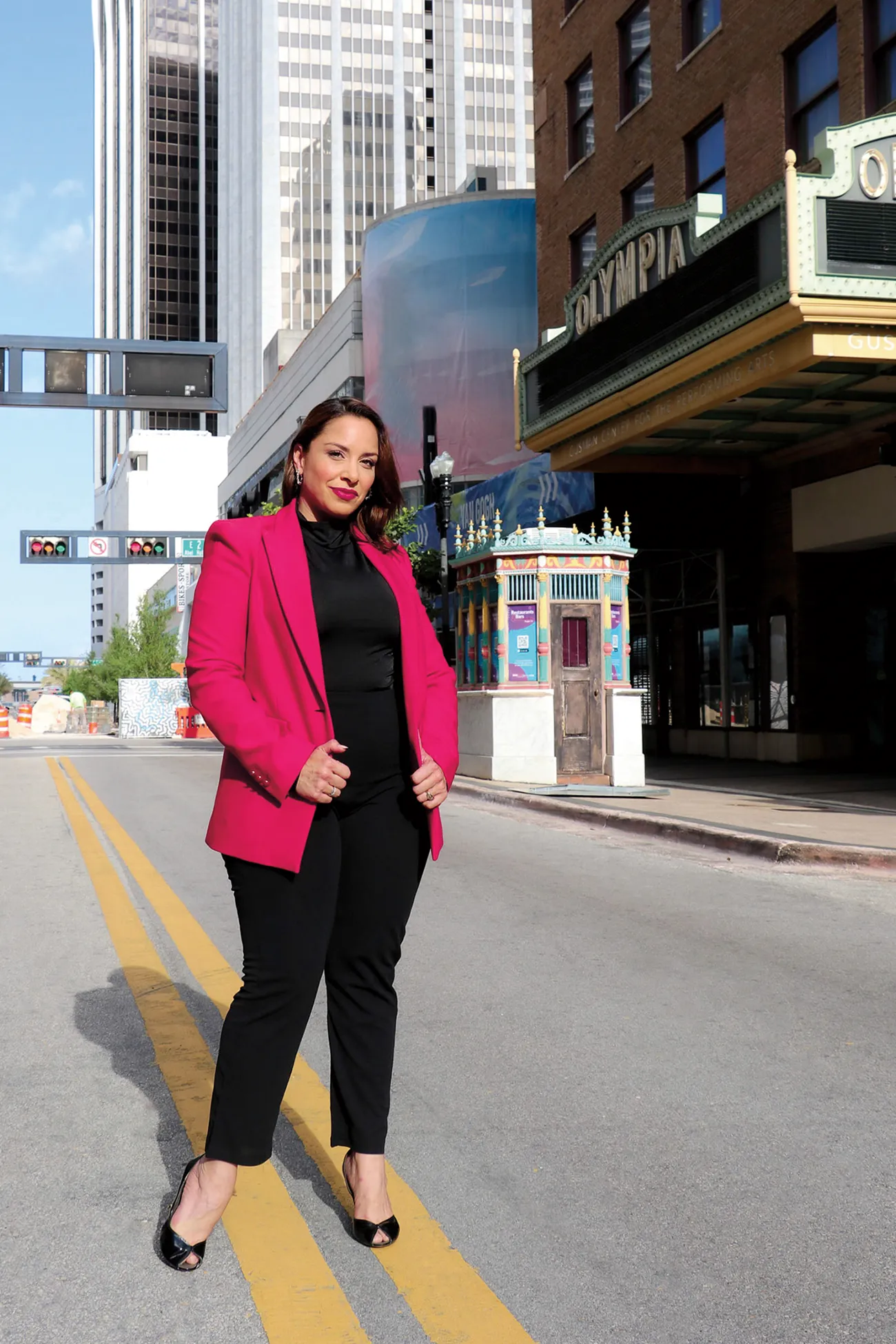
Walking around downtown Miami these days feels like stepping into a different world than even a few short years ago. As one of the fastest-growing districts in the country, the neighborhood seems to sprout something new each week. Tower cranes swing above sidewalks while slower-moving pockets of empty space spark curiosity about what will inevitably rise there next. With a skyline that now rivals Manhattan, bold developers like Moshe Mana mapping out ambitious plans, and news of the city commissioners’ approval to transfer ownership of the historic Olympia Theater to SLAM Academy—the charter school co-founded by rapper Pitbull—downtown Miami has become an epicenter of change that demands attention.
At the center of this transformation is Christina Crespi, chief executive officer and executive director of the Miami Downtown Development Authority. Her role is to harness this energy and ensure the city’s rapid growth is matched with vision, balance, and a focus on the people who live and work in the core.
Born and raised on Miami Beach, Crespi’s journey into public service began early. “I started in public service over 20 years ago as a camp counselor at the city of Miami Beach,” she recalled. “Later, I interned as a caseworker in homeless services and then went on to the county through a management internship program where I learned at the highest levels of government.”
Those early lessons in resilience would guide her through some of the city’s most challenging moments. When the pandemic silenced the city, she helped turn crisis into community. “We brought DJs onto our Instagram channel, and then David Guetta performed on our skyline. We raised over a million dollars for Feeding South Florida in that 45-minute concert,” she said.
Today Crespi is focused on creating a downtown that is more than a financial hub. “We now have almost 50,000 residents living in downtown. We are focusing not only on economic development but also on what it means to live here—clean streets, safety, walkability, and more transit solutions,” she explained.
Addressing homelessness is part of her mandate, and one she speaks about with clarity. “I understand it well, because I worked in it. It’s not easy to fix, but we are advocating solutions. I just hired a case manager last year, and this year we are bringing in a mental health coordinator,” she said. She points to a new county-level mental health facility with 200 beds as “one of the most exciting developments” she has seen.
Culture is just as important as commerce in Crespi’s vision. The Flagler Street Holiday Village drew more than 65,000 visitors. “People from all over Miami came downtown who had not visited in years.
That really struck a chord with me because it’s what I always envisioned—bringing the community back together,” she said. But Crespi is also thinking about what comes next.
Education, she believes, is the cornerstone of a thriving city. “Once students graduate, where do they go? We connected the dots, and within months we had buildings filled with incredible designers. It’s becoming our little fashion hub,” she said. Collaborations with Miami Dade College, Mana Fashion, and local property owners have opened new spaces for showrooms and design studios, ensuring young talent stays in Miami rather than leaving for other cities.
Infrastructure and quality of life are just as high on her agenda. She points to projects like the Baywalk, which will finally connect the waterfront in a continuous promenade, and her vision for expanded water taxis that would let people glide across Biscayne Bay as easily as hailing a car. Parks and public spaces are priorities too. “I think what we are missing is a place where families can come together. Bigger than a Y, a place for everyone,” she said.
For Crespi, downtown Miami’s story is about people as much as skyscrapers. Her vision blends the energy of global business with the intimacy of neighborhood life. “I always say that Miami is a city of partnerships,” she said. “When we work together, we create magic.”
miamidda.com